
USG and Armstrong Mineral Ceiling Systems and Comparison
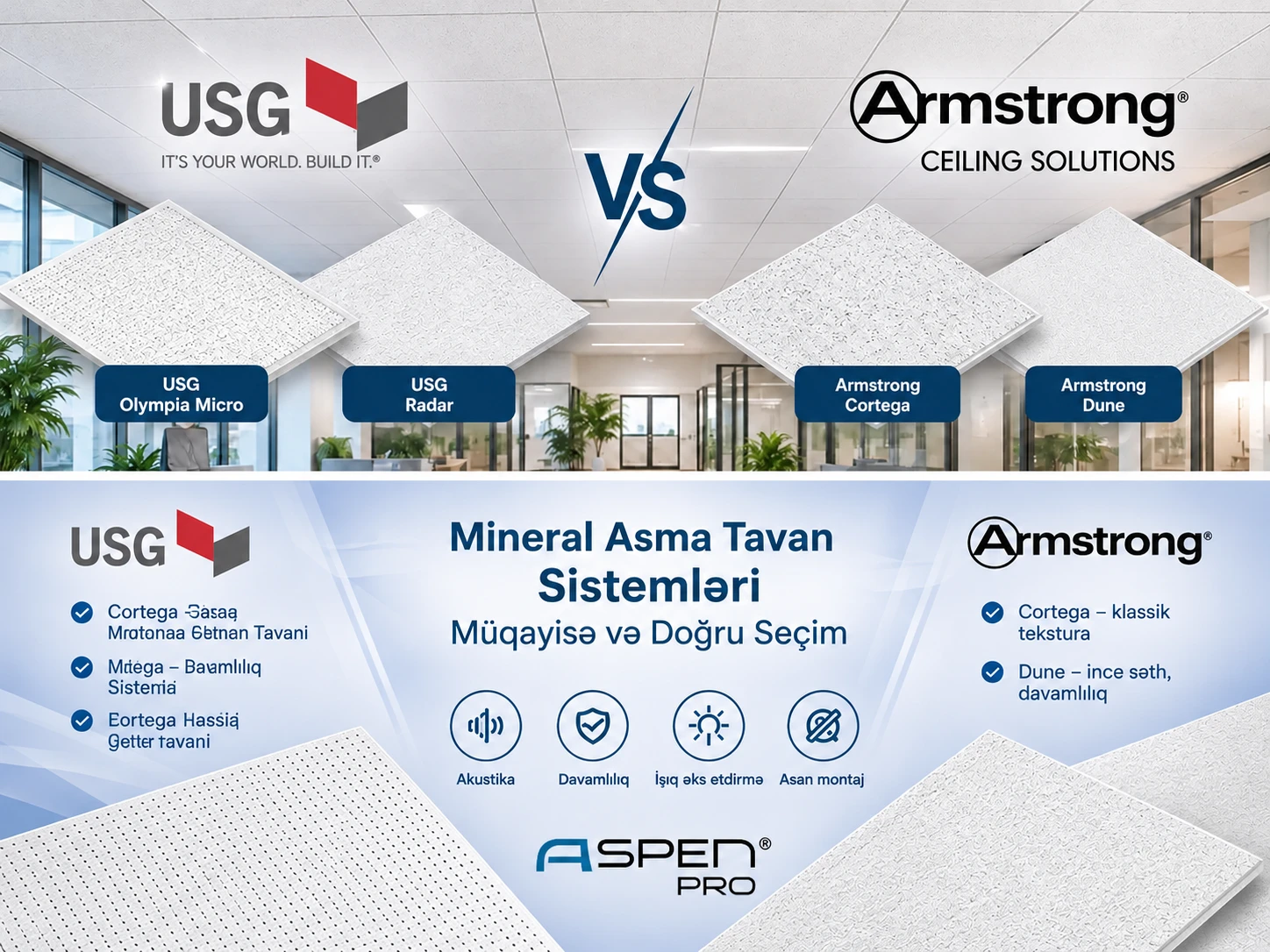
USG and Armstrong Mineral Ceiling Systems: Comparison of Olympia Micro, Radar, Cortega, and Dune
Mineral ceiling systems are widely used in modern offices, business centers, educational institutions, and commercial facilities. These systems not only complement the aesthetic appearance of the interior but also allow for the management of room acoustics, noise control, and the placement of engineering communication systems.
Among mineral ceiling manufacturers, USG and Armstrong are well-known brands in the international market. Both manufacturers offer ceiling panels with various materials, surface textures, sizes, and acoustic indicators.
This article will focus primarily on USG's Olympia Micro and Radar series. For comparison, we will also consider Armstrong's Cortega and Dune mineral-based panels.
The aim is not only to promote the brands but to assist in making the right product choice by comparing their material properties, acoustic performance, technical indicators, and application possibilities.
1. USG Mineral Ceiling Systems
USG (USA) is one of the recognized manufacturers in the field of building materials and interior space solutions. The company's mineral ceiling products are designed to meet various acoustic requirements, interior design needs, and operational conditions.
In the USG product range, the Olympia Micro and Radar series stand out. Although both products are mineral-based, they differ in terms of surface texture, design approach, and technical indicators.
USG Olympia Micro – Microperforated Mineral Ceiling
USG Olympia Micro is an acoustic ceiling panel with a mineral fiber base, featuring a fine and smooth surface. The microperforated surface structure gives the ceiling a neat and modern appearance.
Olympia Micro is particularly suitable for projects that require a simple, clean, and uniform ceiling appearance in their interiors.
The main features of the panel include:
- Mineral-based material.
- Microperforated surface structure.
- Fine and aesthetic appearance.
- Acoustic absorption properties.
- High light reflectance capability.
- Resistance to moisture and sagging.
- Product variants compatible with various support systems.
The standard technical specifications of the USG Olympia Micro product indicate an NRC of 0.50, CAC of 35, and a light reflectance index of 0.86. Some product variants are also offered with an NRC of 0.60.
These indicators make Olympia Micro an interesting choice for office and commercial spaces in terms of both visual appearance and acoustic comfort.
USG Radar – Universal Mineral Ceiling Panel
The USG Radar series stands out among mineral fiber ceiling panels for its universal application possibilities. The panel's surface has a chaotic textured structure. This feature reduces limitations on the orientation of the panels during installation.
The Radar series is designed for use in various interiors. In addition to standard acoustic panels, special variants with higher sound absorption indicators are also available in the product range.
The main features of USG Radar panels include:
- Mineral-based production material.
- Chaotic textured surface.
- Economical price.
- Various acoustic performance options.
- Panel edge profiles tailored to the project.
- Installation possibility with metal T-frame systems.
Radar Open Plan is a special variant designed for open-plan spaces that require higher acoustic performance. In the 15 mm thick version of this product, NRC 0.75, CAC 35, and light reflectance of 0.84 are presented.
Thus, it is important to distinguish between the standard panel and the Radar Open Plan model within the Radar series. The high NRC indicator applies specifically to this product variant, not to all Radar panels.
2. Armstrong Mineral Ceiling Systems
Armstrong (Germany) mineral ceiling panels are well-known ceiling solutions used in commercial and public spaces. In this article, we will look at two product series from Armstrong – the Cortega and Dune panels.
Armstrong Cortega – Classic Textured Mineral Ceiling Panel
Armstrong Cortega is a mineral-based ceiling panel with a medium textured surface. The product stands out with its classic ceiling appearance and standard acoustic properties.
The random surface structure of Cortega panels facilitates the installation process. Models with various sizes and edge profiles are available.
Main features include:
- Mineral fiber-based material.
- Medium textured surface.
- Standard acoustic absorption properties.
- Economical price.
- Various sizes and edge profiles.
- Usability in commercial and office spaces.
The specific model 770 of the Armstrong Cortega product presents an NRC of 0.55, CAC of 33, and light reflectance of 0.80. In other models, the CAC indicator may vary.
Armstrong Dune – Durable and Fine Textured Mineral Panel
The Armstrong Dune series consists of mineral fiber ceiling panels with a fine textured and random surface structure.
The surface of Dune panels is distinguished by its resistance to bending and scratching. Various panel sizes and edge profiles provide options suitable for projects.
Main features include:
- Mineral fiber-based material.
- Fine textured surface.
- Random visual appearance.
- Resistance to bending.
- Additional protection against moisture and sagging in certain models.
- Compatibility with various metal support systems.
The Armstrong Dune product's model 1772 presents an NRC of 0.50, CAC of 30, and light reflectance of 0.81. In other Dune models, CAC can reach up to 35.
3. Material Comparison of USG and Armstrong Panels
One of the key factors affecting the technical characteristics of mineral ceiling panels is the production material.
Components such as perlite, mineral wool, cellulose fibers, glass fiber, and starch can be used in the production of mineral fiber panels. The ratio of these materials and the production technology vary across each product series.
USG Olympia Micro and Radar Materials
USG Olympia Micro is a mineral fiber-based panel. The material structure and surface treatment used in the production of the product shape its acoustic and visual properties.
In some products of the USG Radar series, a wet-formed base material composed of perlite, mineral wool, paper fibers, and starch is used.
This combination of materials affects the acoustic properties of the panel and its overall structural design.
Armstrong Cortega and Dune Materials
Armstrong Cortega and Dune panels are also mineral-based products. The components such as perlite, mineral wool, glass fiber, paper, and starch are indicated in the product documentation disclosed by the manufacturer.
There are differences between these two product series from Armstrong in terms of surface texture and some operational characteristics.
Cortega presents a medium textured surface, while Dune features a finer textured appearance.
4. Comparison of Technical Indicators
When selecting USG and Armstrong mineral ceiling panels, attention should be paid to NRC, CAC, light reflectance, material thickness, and fire indicators.
The following table compares the indicators disclosed by the manufacturers for specific product models.
| Technical Indicator | USG Olympia Micro | USG Radar | Armstrong Cortega | Armstrong Dune |
|---|---|---|---|---|
| Material | Mineral fiber | Mineral fiber | Mineral fiber | Mineral fiber |
| Thickness | 15.9 mm | 22.2 mm | 15.9 mm | 15.9 mm |
| NRC | 0.50 | 0.75 | 0.55 | 0.50 |
| CAC | 35 dB | 35 dB | 33 dB | 30 dB |
| Light Reflectance | 0.86 | 0.84 | 0.80 | 0.81 |
| Fire Indicator | Class A | Class A | Class A | Class A |
Technical Note: The indicators for model 4431 for Olympia Micro and the 15 mm thick variant for Radar have been used in the table. Model 770 has been taken as the basis for Armstrong Cortega, and model 1772 for Dune. Indicators may vary in other models, sizes, and edge profiles. The comparison should be confirmed with the technical passport of the specific product before purchase.
5. NRC and CAC – Key Indicators in Acoustic Ceiling Selection
One of the main functions of acoustic ceilings is to manage sound within the room. In this regard, NRC and CAC indicators are of particular importance.
NRC – Noise Reduction Coefficient
NRC (Noise Reduction Coefficient) is an indicator that expresses the sound absorption capability of the material. The indicator ranges from 0 to 1.
As the NRC increases, the panel's ability to absorb sound energy within the room improves. This feature helps reduce echoes and create a more comfortable acoustic environment.
For example, the NRC of 0.75 for the USG Radar Open Plan model is higher than the standard indicators of the Olympia Micro, Cortega, and Dune models mentioned above.
A high NRC indicator is particularly important in the following spaces:
- Open-plan offices.
- Call centers.
- Conference and meeting rooms.
- Educational institutions.
- Commercial spaces with high human density.
CAC – Reduction of Sound Transmission Between Rooms
CAC (Ceiling Attenuation Class) characterizes the reduction of sound transmission between adjacent rooms through a shared ceiling cavity.
As the CAC indicator increases, the system's performance in this regard improves. For example, a CAC of 35 indicates a higher sound attenuation result than a CAC of 30.
This feature is important for individual workspaces, executive offices, and meeting rooms.
It should be noted that NRC and CAC are different indicators. A high NRC does not automatically imply a high CAC. In projects requiring sound insulation, the ceiling cavity, partitions, and other structural elements should also be evaluated together.
6. Metal Support Frame Systems – USG Donn and Armstrong Prelude
The quality of a mineral ceiling is influenced not only by the panel but also by the metal support structure it is installed on.
USG and Armstrong offer various sizes of T-profiles, main and auxiliary supporting elements, hangers, and perimeter profiles.
USG Donn Systems
USG Donn DX/DXL metal frame systems are designed for the installation of mineral ceiling panels.
Main features include:
- 15 and 24 mm profile variants.
- Galvanized steel supporting elements.
- Different load-bearing classes.
- System variants compatible with various panel edge profiles.
- Integration of lighting and engineering communication elements.
Armstrong Prelude Systems
Armstrong Prelude metal T-frame systems are used for various mineral ceiling panels.
Main features include:
- 15/24 mm profile variants.
- Main and auxiliary supporting profiles.
- Construction options tailored to the project.
- Integration with lighting and ventilation elements.
- Variants compatible with various panel edge profiles.
Although USG Donn and Armstrong Prelude systems have similar functions, their components do not automatically replace each other. The choice of frame should be made according to the panel's edge profile, size, load requirements, and the manufacturer's installation instructions.
7. Which Panel is More Suitable for Which Space?
USG Olympia Micro – Modern Offices and Business Centers
In offices where a fine, microperforated, and neat ceiling appearance is required, Olympia Micro can be a suitable choice. Its high light reflectance property also positively affects the lighting of the interior.
USG Radar – Spaces Requiring Acoustic Performance
Various models of the Radar series meet different acoustic requirements. In particular, the Radar Open Plan can be considered for open-plan offices, educational institutions, and other spaces that require sound absorption due to its high NRC indicator.
Armstrong Cortega – Standard Commercial Spaces
Cortega can be applied in offices and other commercial facilities with its classic textured ceiling appearance and standard acoustic properties.
Armstrong Dune – Spaces Requiring Durable Surface
Dune is an alternative for projects seeking standard mineral ceiling solutions with its fine texture and scratch-resistant surface.
8. How to Make the Right Choice Between USG and Armstrong?
Both manufacturers' products offer technical solutions for various projects. The right choice should not be based solely on the brand name.
When making a choice, the following factors should be evaluated:
- Acoustic Requirement: What NRC and CAC indicators are needed for the space?
- Material: Is the panel's material composition and surface structure suitable for the project?
- Design: Is a microperforated, smooth, or textured surface required?
- Lighting: What is the panel's light reflectance index?
- Moisture: Is the panel's resistance to sagging and moisture sufficient?
- Construction: Is the metal frame compatible with the panel's size and edge profile?
- Operation: What are the cleaning and maintenance requirements?
- Cost-effectiveness: What is the total project cost including panel, frame, and installation?
9. Conclusion – USG Olympia Micro and Radar or Armstrong Cortega and Dune?
USG and Armstrong mineral ceiling systems offer products with different designs and technical indicators.
USG Olympia Micro is distinguished by its fine microperforated surface, high light reflectance index, and functional acoustic properties.
USG Radar provides a wide range of options from standard mineral ceiling solutions to special variants requiring high acoustic performance. In particular, the Radar Open Plan stands out with its high NRC indicator.
Armstrong Cortega is a panel with a classic texture and standard acoustic properties. Dune, on the other hand, is characterized by its fine texture and durable surface.
Therefore, when making a choice, the specific technical indicators of the product, the acoustic requirements of the project, and the installation system should be evaluated together. Relying solely on the brand name or the appearance of the panel may not yield the right result.
10. Aspen Pro – Mineral and Acoustic Ceiling Solutions
Aspen Pro pays particular attention to providing ceiling and acoustic solutions for modern offices, business centers, and commercial facilities.
In selecting mineral ceiling systems, the main criteria for our company are the quality of the material, acoustic indicators, reliability of the supporting structure, and the technical requirements of the project.
The comparison of products such as USG Olympia Micro and Radar, as well as Armstrong Cortega and Dune panels, helps determine the right ceiling solution for the facility.
Aspen Pro can assist you in selecting and implementing solutions suitable for your project regarding mineral ceilings, acoustic ceilings, and other modern ceiling systems.
For more information: Mineral Stone Wool Ceiling - Aspen Pro
Frequently Asked Questions (FAQ)
What is USG Olympia Micro?
USG Olympia Micro is an acoustic ceiling panel made of mineral fiber with a microperforated surface structure. It features a fine appearance, an NRC of 0.50, and a CAC of 35.
What is the main advantage of the USG Radar panel?
The Radar series offers product variants with various acoustic indicators. The NRC of the Radar Open Plan model reaches 0.75.
What is the difference between USG Olympia Micro and Radar?
Olympia Micro has a microperforated and finer appearance. Radar is distinguished by its light texture and universal surface structure. The Radar series includes special variants with higher NRC indicators.
What is the difference between Armstrong Cortega and Dune?
Cortega has a medium textured surface, while Dune features a finer textured and scratch-resistant surface. Both products are mineral fiber-based.
What do NRC and CAC mean?
NRC characterizes the sound absorption capability within the room, while CAC characterizes the reduction of sound transmission between adjacent rooms through a shared ceiling cavity.
Does a mineral ceiling reduce noise in the office?
Yes. Mineral ceiling panels with appropriate acoustic indicators help reduce sound reverberation within the room. Additional structural solutions may be required for sound insulation between rooms.
Are USG Donn and Armstrong Prelude systems the same?
Both systems serve the function of a metal support frame. However, due to differences in profile and connection elements, their compatibility should be checked separately.